Ningbo Bohua Mechanical Parts Co., Ltd. · Linda, Export Sales · linda@ningbobohua.com · www.bohua-casting.com
Engineering guide
LPDC vs Gravity Die Casting: Aluminum Process Differences
LPDC pushes molten aluminum upward into a mold with controlled furnace pressure. Gravity casting fills through a gravity-fed gating system, with static or tilt-pour arrangements. Compare the routes against the same geometry, alloy, finishing scope and acceptance criteria. Bohua has performed low-pressure casting in-house since 2014 and operates both tilt-pour and vertical gravity casting machines.
On this page
Compare the filling route first
Low pressure die casting (LPDC) and gravity casting are both permanent mold processes for aluminum —they use reusable steel or cast iron molds, produce parts with good mechanical properties, and support heat treatment. To many procurement managers, they look interchangeable on paper.
They are not. The filling mechanism is fundamentally different, and that difference cascades into quality characteristics, tooling requirements, cycle times, and total part cost. Choosing the wrong process for your geometry and volume can mean paying significantly more per part or accepting quality trade-offs that create field risk.
At Bohua
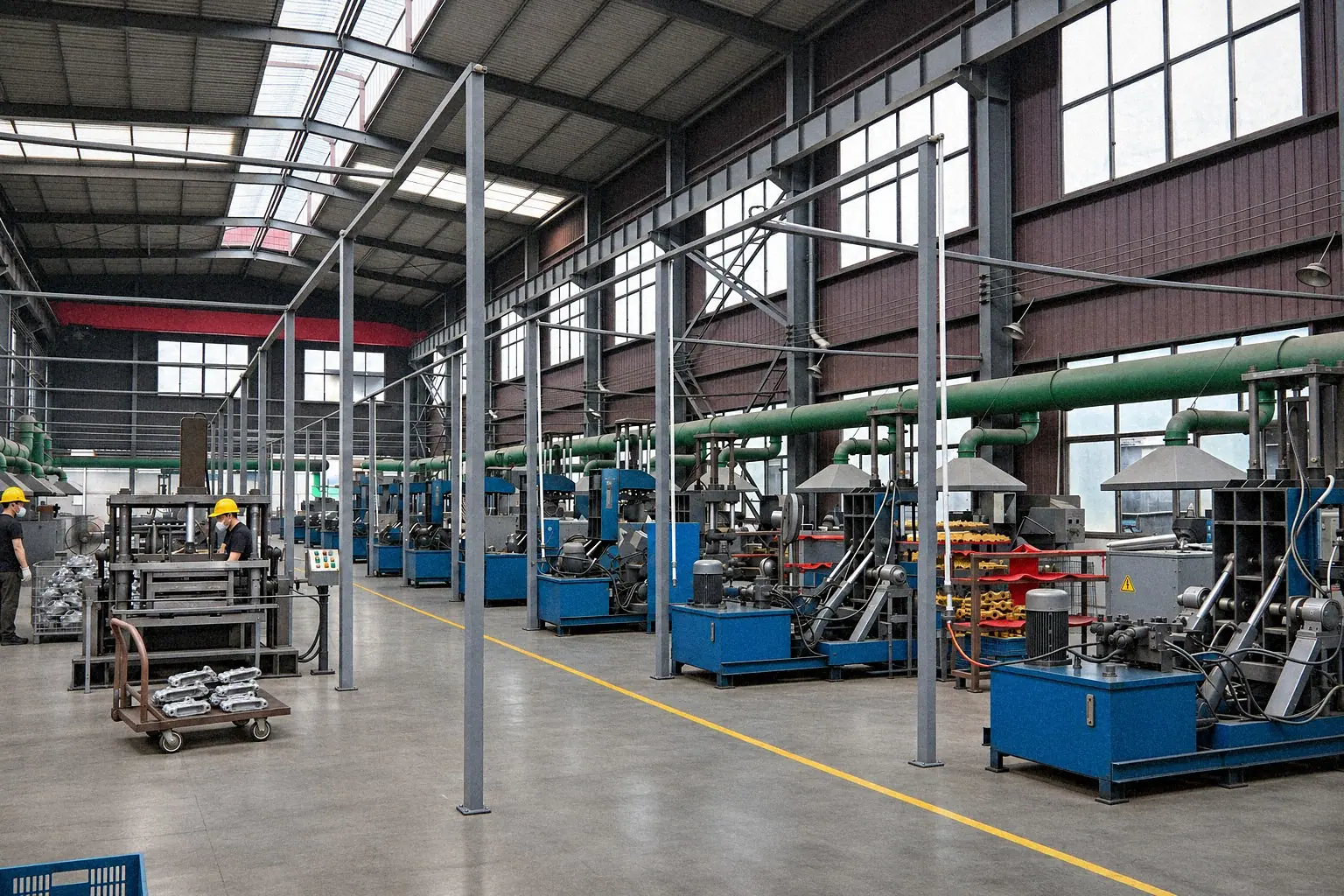
Bohua has performed low-pressure casting in-house since 2014 as an established process. Sand casting is also performed in-house. Our main gravity-casting resources include 32 tilt-pour machines and 10 vertical gravity casting machines. Some tilt-pour machines were designed and built in-house.
The main routes are gravity casting and tilt-pour casting. Low-pressure casting has been in-house since 2014. Sand casting is done in-house. This guide explains general engineering differences. Bohua's recommendation for a part is made from the drawing and the acceptance requirements.
How Gravity Casting Works
In gravity casting, molten aluminum is ladled from a holding furnace and poured into the mold cavity from above. The metal fills the cavity under gravitational force only —no external pressure is applied during filling.
The ladle supplies the gating system; the actual cavity may fill from a lower gate. The following arrangements describe conventional layouts, not a restriction on all gravity tooling.
Key Process Characteristics
- Filling pressure: atmospheric only (~1 bar)
- Filling direction: top-down or side-gated, with risers above the cavity
- Mold orientation: typically horizontal or tilted
- Mold material: steel or cast iron, gravity-assisted ejection or manual removal
The gating system (sprue, runner, gates) and riser placement are designed to manage the filling front and feed solidification shrinkage. Proper mold coating and preheating are essential for consistent results.
Process Variants
The benefit of a tilt sequence depends on the tool, pouring cup, fill profile and melt handling. These are general process variants:
- Static pour: mold is stationary, metal poured from a ladle
- Tilt pour: mold tilts during filling for more controlled, laminar metal flow —reduces turbulence and oxide entrainment
- Semi-automated: robotic ladling or auto-pour systems for cycle consistency
For the equipment and project scope, see Bohua gravity casting and the tilt-pour permanent mold process.
At Bohua
Bohua reports tilt-pour capability for molds with a longest side above 800 mm and pouring charges above 30 kg. On the tilt-pour route, casting weights extend below 0.2 kg and above 30 kg, with the largest parts longer than 600 mm. Typical tilt-pour walls are about 3 mm; the 2.5 mm capability is confined to small areas near the gate. These are reported scope statements, not maximum machine limits or low-pressure casting limits.
How Low Pressure Die Casting Works
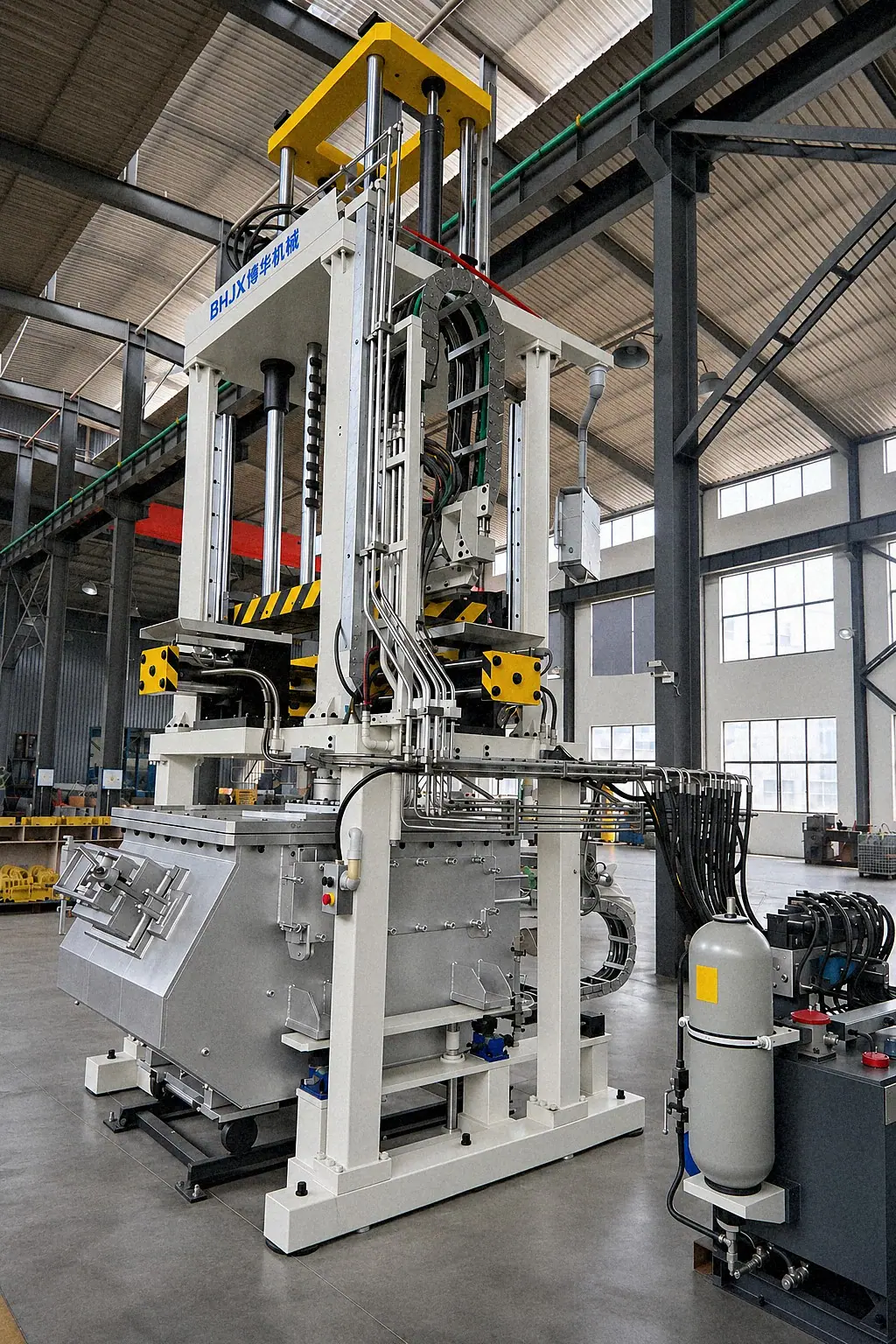
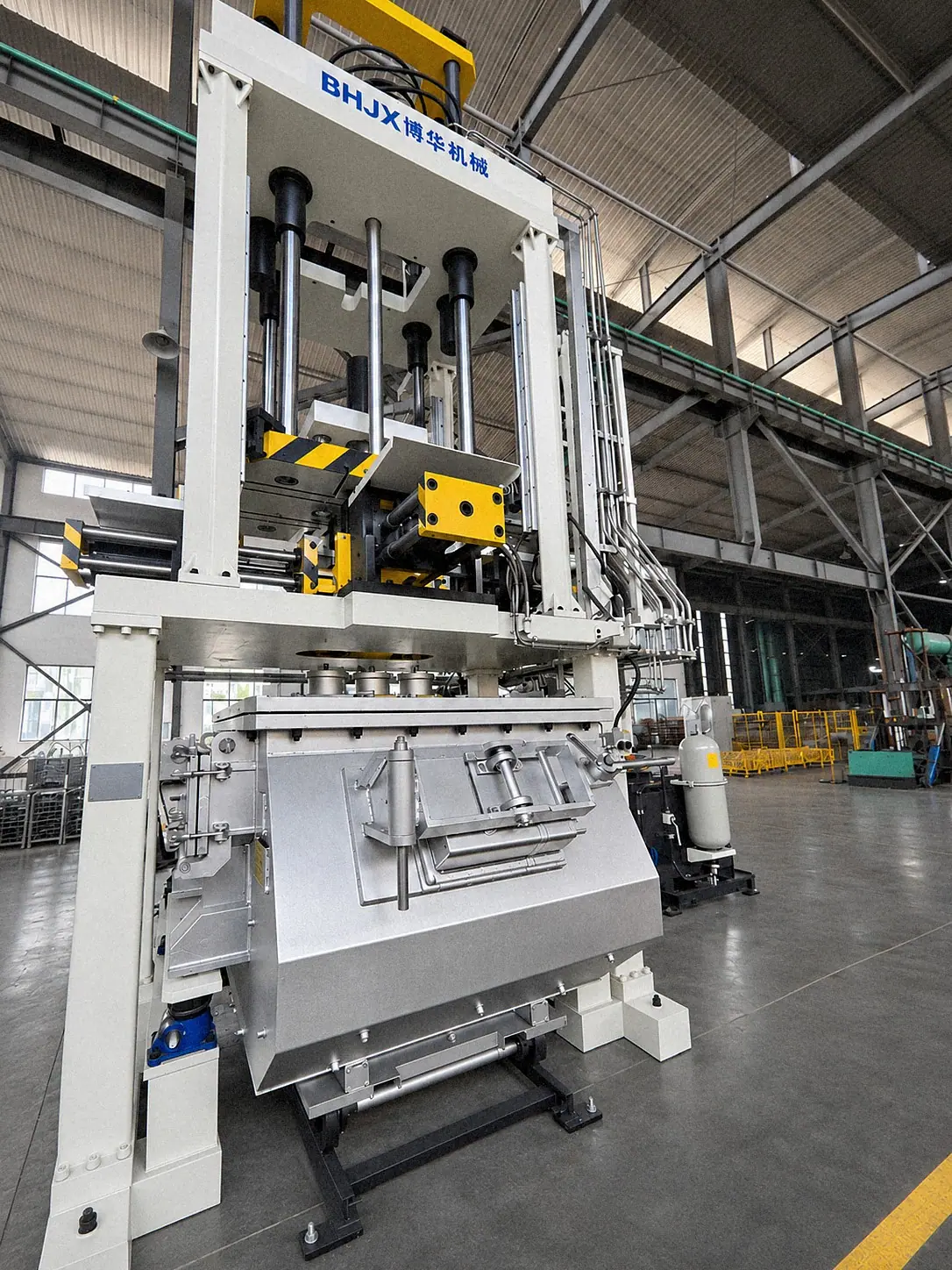
In LPDC, the mold sits above a sealed furnace. Low pressure air (typically 0.3–0.7 bar above atmospheric) is applied to the surface of the molten metal, pushing it upward through a riser tube (stalk) into the mold cavity from below.
This is a general pressure reference, not a Bohua machine setting. The required pressure curve depends on lift height, metal level, geometry and feeding requirements. The absolute-pressure figures below use an atmospheric reference of 1 bar.
Key Process Characteristics
- Filling pressure: 0.3–0.7 bar gauge (1.3–1.7 bar absolute)
- Filling direction: bottom-up through a central stalk
- Mold orientation: mold above furnace, stalk enters from bottom
- Fill time: determined by the geometry and qualified filling curve
- Mold material: steel or cast iron, often with complex cooling systems
The Pressure Advantage
The controlled bottom-filling in LPDC offers several metallurgical advantages:
- Reduced turbulence —metal rises smoothly into the cavity without splashing or folding
- Better feeding —pressure is maintained during solidification, pushing additional metal into shrinking sections
- Lower oxide entrainment —the metal surface in the furnace is protected, and the fill front is less disrupted
- More directional solidification —bottom-up filling naturally promotes solidification from the top (farthest from the stalk) downward toward the pressurized feed
This makes LPDC particularly effective for parts where internal integrity is critical —pressure-tight housings, structural nodes, and components requiring consistent mechanical properties throughout.
These are potential benefits of a controlled bottom-fill route. The pressure curve must preserve the feed path, and local cooling must support the intended solidification sequence. Specify porosity acceptance and mechanical-property targets, then verify them on parts made by the proposed route.
General LPDC pressure reference: Protocast, Low Pressure Permanent Mold Casting. Filling and feeding principles: European Aluminium, Casting methods, version 2002, sections 1.5–1.6. These describe process principles, not Bohua operating limits.
Difference Between HPDC and LPDC
HPDC injects metal rapidly with a plunger, while LPDC uses furnace gas pressure to raise metal through a stalk into the mold.
| Buyer question | HPDC | LPDC |
|---|---|---|
| Pressure and measurement point | Metal pressure after filling can exceed 70 MPa (700 bar). | Furnace gas pressure is typically below 1 bar above atmospheric pressure. |
| Filling method | Fast plunger injection into the die. | Controlled filling from below through a submerged stalk. |
| Wall-thickness reference | The 2002 automotive comparison lists 2.5 mm minimum standard walls and 1.5 mm local walls. | The same comparison lists 5 mm minimum standard walls and 4 mm local walls. |
| Typical parts | Transmission cases and belt tensioners. | Wheels and cylinder heads. |
| Heat treatment | Conventional HPDC has gas-related blistering limits; suitable vacuum-assisted routes and alloys can permit heat treatment. | Heat treatment is possible with a suitable alloy and qualified treatment. |
| Mold cost | Higher initial tooling investment in the cited standard-part comparison. | Lower initial tooling investment in that comparison; part geometry still controls the quote. |
Sources: European Aluminium Association, Aluminium Automotive Manual, Version 2002, pp. 33, 36, 38–45 and 81; European Aluminium, ordering guide, 4th edition, June 2019, p. 17. The wall figures are dated automotive design references, not universal process limits or Bohua capabilities. The two pressure figures refer to different measurement points and stages.
At Bohua
Bohua has carried out low-pressure casting in-house since 2014 and has two die-casting machines, rated at 280 tonnes and 450 tonnes.
Head-to-Head Process Comparison
Both processes support heat treatment and can achieve comparable final mechanical properties when alloy and process are correctly controlled.
| Decision factor | Gravity casting | Low-pressure casting |
|---|---|---|
| Filling route | Ladle-fed gating; static or tilt-pour arrangement | Metal rises from a sealed furnace through a stalk |
| Feeding review | Gate and riser design must feed shrinking sections | Applied pressure feeds through a path that must remain open |
| Core and tooling review | Check core support, venting and mold release | Check core support, stalk entry, venting and thermal control |
| Quality evidence | Agree internal inspection zones and functional tests | Use the same zones, test stages and acceptance limits |
| Productivity evidence | Request the proposed cavity count and qualified cycle | Request the proposed cavity count and qualified cycle |
There is no universal porosity, fatigue-life or cost ranking. Compare the specified alloy, temper, specimen basis and inspected regions before accepting a performance claim.
At Bohua
For a dimensional comparison, Bohua states routine as-cast accuracy as CT8. Its limit for critical machined dimensions is ±0.02 mm; machining to ±0.005 mm is outside its capability.
| Comparison input | Gravity / tilt-pour evidence | Low-pressure input still needed |
|---|---|---|
| Part size and thin walls | Tilt-pour scope stated above | Confirm the drawing-specific weight, envelope and wall requirements |
| Dimensions | Separate as-cast requirements from machined requirements | Request the same features and measurement stage |
| Melt treatment | Rotary-treatment practice described below | Confirm the proposed melt and filling control plan |
| Acceptance | Use the drawing and specified inspection zones | Apply matching functional requirements and evidence |
Cost Comparison
Cost comparison between gravity and LPDC is not straightforward because the two processes have different cost structures.
Actual costs depend on part geometry, alloy, quality requirements, and regional labor rates.
Assess tooling, metal yield, cycle time, core work, machining, inspection, scrap, packaging and delivery on the same basis. A claimed yield advantage needs a stated calculation basis and part-specific records.
Gravity equipment and changeover considerations
For conventional gravity equipment, compare the following features with a dedicated sealed-furnace LPDC setup. Shorter setups and lower tooling amortization apply only where the proposed tooling and production plan demonstrate them.
- Equipment
- no specialized machine or sealed furnace required
- Flexibility
- easier to run mixed-part production, shorter setup times
- Low to medium volume
- tooling amortization is lower per part
Where LPDC Can Be More Economical
Metal yield
Compare the actual mass of usable castings with the metal poured, using the same calculation basis for both routes.
A cost advantage is conditional on measured reductions in downstream losses. Check these possible contributions rather than assuming they occur on every drawing:
- Reduced scrap: better internal quality means fewer rejects, especially for pressure-tested or X-ray inspected parts
- Less rework: fewer porosity-related machining rejects and leak test failures
- Reduced risering: smaller or no risers means less trimming and less material waste
At Bohua
Bohua quotations are based on annual volume and the specified casting, machining and inspection scope. MOQ: quoted by annual volume; small batches negotiable.
When each route deserves review
The selection depends on whether the proposed route meets the drawing and the accepted total cost.
When to Choose Gravity Casting
Review gravity casting when:
- the proposed feeding and core arrangement meet the geometry;
- the alloy and heat-treatment route meet the required properties;
- the verified tooling, conversion and downstream costs support the program.
When to Choose Low Pressure Casting
Consider LPDC when the geometry benefits from bottom filling and the pressure-fed route meets the same functional acceptance criteria.
Process Selection Is Part-Specific
The right answer is rarely always gravity or always low-pressure casting. Compare each part against the drawing, annual volume, and acceptance requirements.
Common Misconceptions
Compare the inspection results for your specified alloy, geometry and acceptance requirements when judging either process.
"LPDC is always better quality than gravity casting"
Not necessarily. A well-controlled tilt-pour gravity casting process with proper melt treatment can produce parts that meet automotive structural requirements. LPDC has inherent advantages in feeding and turbulence control, but these advantages only matter if the part design and quality requirements demand them.
"Gravity casting cannot make pressure-tight parts"
Gravity casting can make pressure-tight parts when the complete casting and machining route meets the specified test.
The key is proper alloy selection, melt treatment (degassing, grain refinement), gating design, and process control.
At Bohua
For the gravity-route melt treatment discussed here, Bohua uses a 15–20 minute rotary cycle. The confirmed rotor range is 480–520 rpm, using purge gas. These treatment settings describe the melt operation, not the pressure curve of a low-pressure machine. See the melt-treatment and release sequence.
"LPDC is too expensive for smaller quantities"
The break-even depends on part size, scrap sensitivity, and quality requirements. For some safety-critical parts, the reduced scrap and rework cost of LPDC can justify the higher tooling even at lower volumes. Always run a total cost model rather than comparing unit prices alone.
"You can just switch between processes without re-tooling"
Gravity and LPDC molds are fundamentally different —the gating location, stalk entry, cooling circuit design, and ejection system are all process-specific. Switching processes means new tooling, new qualification, and potentially new alloy or heat treatment parameters.
For a conversion, review the tooling changes and qualification work before deciding which existing tool elements can be reused.
Hybrid and Emerging Approaches
The boundary between gravity and low pressure casting continues to evolve:
These are general process variants, not additional Bohua capabilities. The tilt-pour comparison concerns conventional equipment; verify turbulence reduction and tooling scope on the actual design.
Enhanced Gravity Methods
- Tilt-pour gravity casting closes much of the turbulence gap with LPDC while keeping the simpler equipment and lower tooling cost
- Gravity casting with local squeeze pins can densify critical zones without full low-pressure infrastructure
Counter-Pressure and Differential Pressure
Some advanced foundries use differential pressure casting, where pressure is applied both above (in the mold) and below (in the furnace).
The comparison below assumes a separately controlled mold chamber added to a conventional LPDC arrangement.
This provides even more precise control over fill rate and solidification feeding than standard LPDC, but at higher equipment cost.
Confirm the control capability and equipment scope for the proposed system.
Decision Framework
When evaluating gravity vs LPDC for a new part, work through these questions:
The weight comparison assumes that a metal-yield advantage has been demonstrated on the same calculation basis. Include gates, risers and expected tooling revisions in the review.
- What are the integrity requirements? (pressure test? X-ray level? fatigue life?)
- What is the annual volume?
- How heavy is the part? (heavier parts benefit more from LPDC's yield advantage)
- What is the tooling budget?
- Is geometry suited to bottom-fill? (symmetrical, flat-bottom parts favor LPDC)
- What is the total cost target? (include scrap, rework, and yield —not just unit price)
If the answers are mixed, request quotes for both processes and compare total landed cost including quality risk.
At Bohua
Bohua designs and makes molds in-house and completes T5 and T6 heat treatment in-house. Machining equipment includes 16 vertical machining centers. Our leak testing uses air-under-water immersion at 3 bar or more. Define the material condition, machined features, inspection areas and test conditions before comparing quotations.
For a coolant water outlet casting, mark the fluid passage, sealing faces and pressure boundary before comparing routes.
Conclusion
Low pressure and gravity casting are complementary processes, not competitors.
Where the proposed tooling, fill route and measured production results support these trade-offs:
Compare gravity casting and low-pressure casting on the same drawing: feeding path, quoted tooling scope, and the acceptance evidence the part requires.
These are conditional advantages; verify them for the same drawing and acceptance requirements.
The procurement mistake is choosing based on habit or headline price. The engineering mistake is assuming one process universally outperforms the other. The right choice comes from matching process capability to part requirements —geometry, volume, quality, and total cost.
Submit the RFQ details, then email your drawing to Linda for a structured quote review. Send the drawing, target alloy, annual volume, and delivery timing. Quotes are by annual volume; small batches are negotiable.
Submit the RFQ details here, then email your drawing for a structured DFM review and quote. Use the casting process review request.
Send your drawing for a process review
Include the drawing revision, alloy, annual volume, machining scope and acceptance requirements. Submit the RFQ details, then email your drawing for a structured quote review. Send the drawing, target alloy, finishing scope, MOQ, and delivery timing. Bohua will review it like a real sourcing project, not a generic contact request. Our engineering team can recommend the right alloy, process, and design optimizations for your specific requirements.
Send your drawing →