Ningbo Bohua Mechanical Parts Co., Ltd. · Linda, Export Sales · linda@ningbobohua.com · www.bohua-casting.com
Company
Aluminum Foundry Quality Certifications
Bohua holds IATF 16949:2016 certification issued by NQA, with validity through November 20, 2027. Use the controlled certificate to verify the legal entity, manufacturing site, exact scope, and current status for supplier approval. For part approval, send your drawing and required inspection records so we can review the evidence needed for your project.
Confirmed certification details
Bohua has an NQA-issued IATF 16949:2016 quality-system certificate. The confirmed validity date is November 20, 2027; check current status as part of your supplier approval.
At Bohua
| Item | Confirmed information |
|---|---|
| Company | Ningbo Bohua Mechanical Parts Co., Ltd. |
| Location | Ningbo, Zhejiang, China |
| Quality-system standard | IATF 16949:2016 |
| Certification body | NQA |
| Certificate validity | Through November 20, 2027 |
| Separate ISO 9001 certificate | No separate certificate; ISO 9001 requirements are incorporated within the IATF 16949 system |
| Part approval support | PPAP documentation up to Level 5, according to project requirements |
The company and city above identify Bohua. Compare them with the exact legal entity, full site address, and scope printed on the controlled certificate. Verify current status through the issuing body and record the result alongside the expiry date.

ISO Requirements for an Aluminium Foundry
IATF 16949:2016 builds on ISO 9001:2015 quality-management requirements and adds automotive-sector requirements. AIAG's IATF 16949:2016 overview explains that it is implemented together with ISO 9001:2015 as a supplement.
At Bohua
Bohua holds an NQA-issued IATF 16949:2016 certificate valid through November 20, 2027.
Bohua does not hold a separate ISO 9001 certificate; the ISO 9001:2015 requirements are part of its IATF 16949:2016 quality system.
When screening an aluminium casting supplier against ISO-based requirements, identify the actual certificate held and match its scope to the manufacturing site. Quality-system certification does not certify every individual casting.
Verify the certificate before supplier approval
Match the certificate to the company and production site you intend to approve. Keep the verification evidence with your supplier file.
- Obtain the controlled copy. Request the certificate and any scope or site attachments. Record the issue date, expiry date, certificate reference, and issuing body.
- Match the entity and site. Compare the supplier on the contract with the legal name and production address on the certificate. Check any site identifier printed on the document.
- Read the exact scope. Check whether the manufacturing activities required for your order fall within that scope. Do not assume that another workshop, affiliate, or outside processor is covered.
- Check current status. Use the verification route stated by the issuing body. Record the date, result, and document reference. Resolve differences between the certificate and the quoted production site before approval.
- Review relevant audit evidence. If your approval process requires it, request a shareable audit summary and the status of relevant corrective actions. Agree on confidentiality and the evidence needed to close an open issue.
For the wider purchasing decision, use the casting supplier evaluation checklist.
Separate system certification from part approval
A quality-system certificate and a part inspection report answer different questions. Define the evidence for your drawing as well as the evidence for supplier qualification.
| Document | Check | Limit |
|---|---|---|
| Quality-system certificate | Entity, site, issuing body, exact scope, dates, and current status | Request drawing-linked inspection results to approve the individual casting |
| Material or treatment record | Alloy, condition, lot identity, method, and required results | Add final dimensional and pressure-tightness results where the drawing requires them |
| Inspection report | Drawing revision, sample identity, method, conditions, actual results, and acceptance criterion | Covers only the recorded features and test scope |
| PPAP submission | Customer-required level, submission content, sample scope, and approval decision | Obtain the customer approval decision; agree new submissions for other parts or later changes |
Bohua supports PPAP documentation up to Level 5. Specify the required level and customer forms; the PPAP evidence planning guide covers the submission inputs.
For drawing-specific approval, request the applicable process flow, control plan, risk analysis, measurement-system evidence, inspection reports, and traceability links. Ask which documents cover first samples and which cover routine shipments. Agree inspection frequencies and request process capability results for the features your approval plan covers.
Match the manufacturing route to the approval scope
Identify the required operations and their locations before accepting a certificate as relevant to the order. Review outside processing separately from the certified site.
At Bohua
Casting, core making, tooling, T5/T6 heat treatment, CNC machining, and inspection share a site of about 16,300 m². Confirmed inspection equipment includes Hexagon Global S and NANO Metrology CMMs and an HBE-3000A hardness tester.
Use the equipment photographs to identify inspection methods for your project. Request the controlled certificate and drawing-linked reports for the approval file.
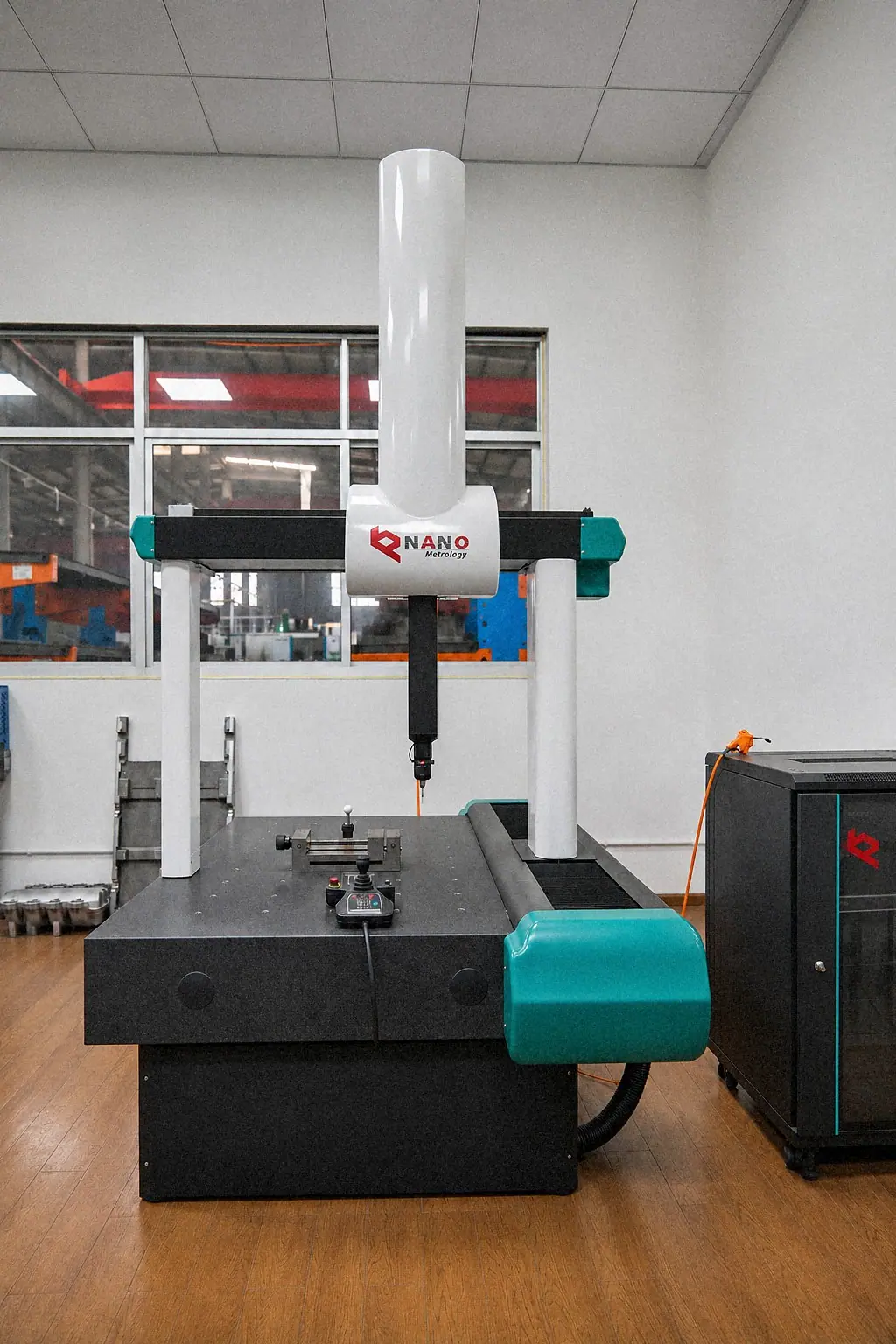

Use Bohua inspection equipment and quality-record requirements for testing scope. Use Bohua gravity casting capabilities for the manufacturing route.
If an order includes outside processing, ask who controls provider approval, traceability, changed process conditions, and the required records. Verify the outside provider's certification separately when your approval requirements call for it.
Send a focused supplier-approval request
Send the drawing and your approval checklist together so certificate verification and part evidence can be reviewed against the same project.
- Controlled 2D drawing and 3D model, alloy, delivered condition, and machining scope.
- Required certificate scope, site verification, audit evidence, and customer-specific requirements.
- Critical characteristics, acceptance criteria, sample quantity, and required inspection records.
- PPAP level or other approval package, document format, annual volume, and target milestones.
- Any outside-process restrictions and rules for changes, deviations, containment, and corrective-action closure.
For a bracket program, use the automotive suspension bracket RFQ requirements. Send your approval package through the casting quotation request.
Send your drawing and inspection requirements
Include the drawing revision, material, annual volume, acceptance criteria, and required records. Not sure which process fits? Tell us what the part must do. In a free drawing review, our engineers recommend a process and suggest design changes where needed.
Send your drawing →