Ningbo Bohua Mechanical Parts Co., Ltd. · Linda, Export Sales · linda@ningbobohua.com · www.bohua-casting.com
Engineering guide
Aluminum Gravity Casting Process: Steps, Alloys & Tips
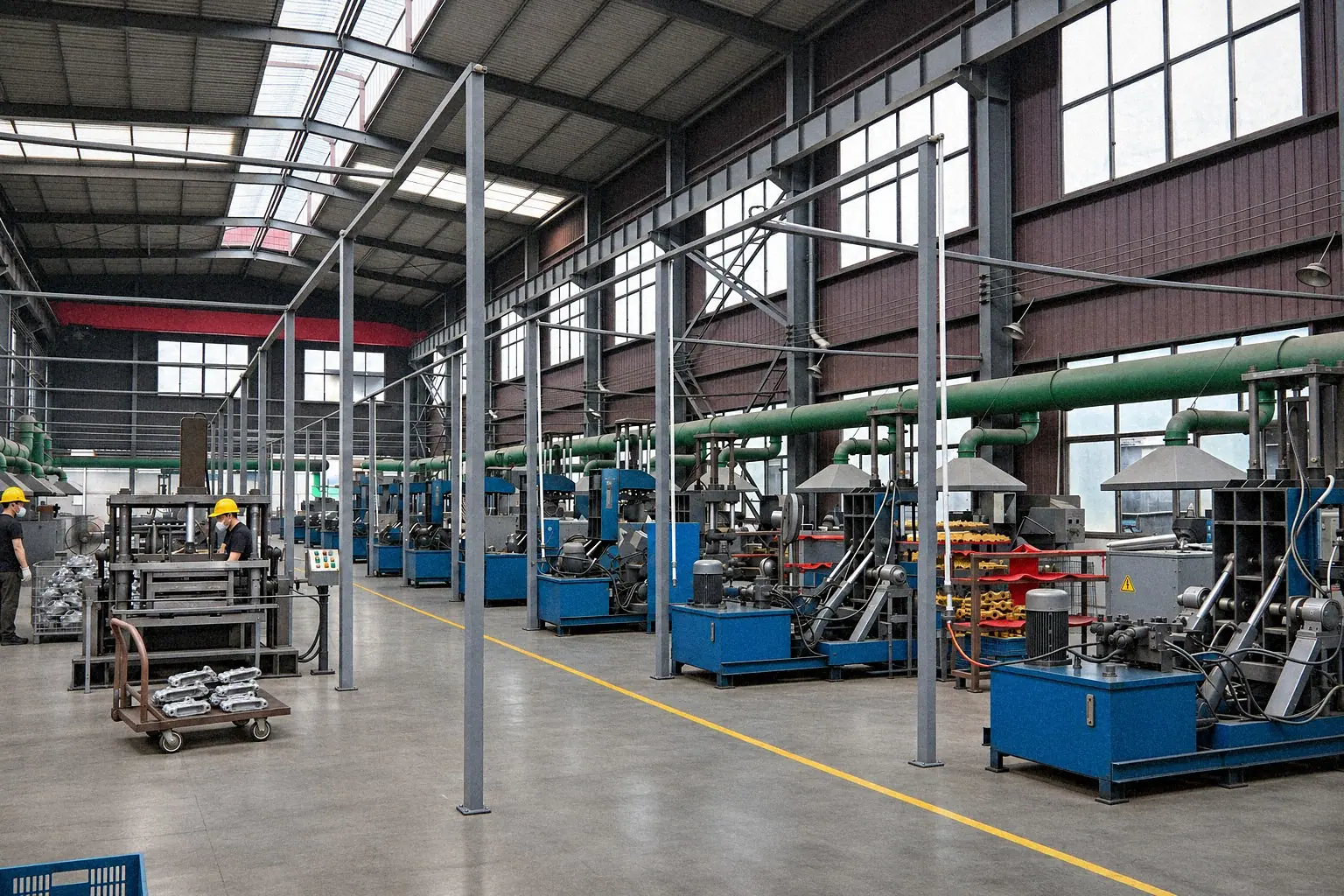
Aluminum gravity casting follows five main stages: mold preparation, pouring, solidification and feeding, ejection, and finishing. Control points connect melt condition and mold readiness to internal soundness, machined dimensions and inspection. Bohua uses 32 tilt-pour machines and 10 vertical gravity casting machines; the checks and acceptance limits still depend on the drawing.
On this page
Gravity casting workflow
Gravity casting is a process in which molten aluminum is poured into a reusable metal mold and fills the cavity under gravity only, without high-pressure injection. The mold is usually steel or cast iron, designed with gating and riser systems to control flow and feed shrinkage during solidification.
For conventional sand casting, gravity casting and high pressure die casting, the following positioning is a starting point for a drawing-specific review.
It sits between sand casting and high pressure die casting in both capability and economics.
This guide explains how the process works, where it outperforms alternatives, and how to evaluate it for your next program.
The following comparison concerns gas entrapment in conventional high-speed HPDC without vacuum assistance; it is not a ranking of grain refinement or every modern casting route.
Here, density refers to reduced gas-pore content. Actual porosity still depends on melt quality, gating, feeding and process control.
With a suitable heat-treatable alloy, controlled filling and adequate feeding, the potential benefits to verify are:
- better mechanical properties after heat treatment
- improved pressure-tight performance
Gravity casting is commonly selected for structural or semi-structural parts where long-term durability matters more than ultra-fast cycle time.
For terminology and design boundaries, see the permanent mold casting guide.
The 5-Step Aluminum Gravity Casting Process
A stable result depends on disciplined execution at each stage.
Use the general engineering sequence below to identify your control points. Agree the control plan for your Bohua part against its drawing and acceptance requirements.
Step 1: Mold Preparation
Permanent mold casting begins with mold readiness. Before pouring, the mold is:
- cleaned to remove prior-cycle residue
- coated with a refractory release layer
- preheated to a controlled temperature window
- assembled and checked for vent and gating condition
The mold coating serves multiple purposes: it protects tool surfaces, controls local heat transfer, and supports clean release during ejection. Preheating reduces thermal shock and helps the first metal front flow consistently, especially in sections with varying wall thickness.
Step 2: Pouring
Molten aluminum is transferred from holding furnace to mold using controlled ladling practice. Pouring speed and stream stability are critical. If pouring is too aggressive, turbulence introduces oxide films and gas. If too slow, misruns and cold shuts become more likely.
Control points include:
- melt temperature at pour
- hydrogen and inclusion status from melt treatment
- ladle cleanliness and transfer time
- operator method and consistency
At Bohua
Bohua has an Oxford optical emission spectrometer and a vacuum hydrogen analyzer. Inspection scope and limits must follow the alloy and approved project requirements.
At Bohua
Before gravity pouring, Bohua uses rotary melt treatment for 15–20 minutes. The rotor operates at 480–520 rpm with purge gas. The baffle is raised to form a vortex for flux-assisted dross removal and lowered to suppress the vortex during degassing.
Bohua accepts the reduced-pressure sample when its surface is slightly concave and its cut section shows essentially no pores. Each heat proceeds to pouring only after the vacuum hydrogen check and Oxford spectrometric analysis both pass. A surface flash observed during treatment is not a release criterion.
| Stage | Bohua practice | Decision boundary |
|---|---|---|
| Melt treatment | Rotary treatment; raised baffle for flux-assisted dross removal, lowered baffle for degassing | Complete treatment before the release checks |
| Reduced-pressure sample | Slightly concave surface; essentially pore-free cut section | A treatment observation does not replace the sample check |
| Composition | Oxford spectrometric analysis | Both composition and the vacuum hydrogen check must pass |
| Temperature | Set for the customer part | Use the part-specific requirements; no common pouring or mold-temperature range is stated |

Step 3: Solidification and Feeding
After filling, the casting solidifies in the metal mold. This stage determines most internal quality outcomes. Proper gating and riser design keep feed paths open long enough to compensate for solidification shrinkage in heavy sections.
Chills may be added where directional solidification is needed, and process windows are tuned to keep shrinkage porosity away from critical zones.
Filling control limits gas and oxide entrainment. Feeding and local cooling address solidification shrinkage; slower cooling alone does not remove trapped gas.
Step 4: Ejection
Once the part reaches safe release temperature, the mold is opened and the casting is removed. Ejection may be manual or assisted depending on part geometry. The goal is to avoid distortion while maintaining cycle time.
Tool maintenance discipline is important here. Sticky release, surface buildup, or ejector wear can quickly create dimensional drift or cosmetic defects.
Step 5: Finishing and Secondary Operations
After removal, gates and risers are trimmed. Depending on specification, parts then move through:
- shot blasting or surface cleaning
- heat treatment (for alloys like A356)
- CNC machining of functional features
- leak testing, dimensional inspection, and final visual standards
This step is where casting quality is converted into final product capability. A good casting process without controlled machining and inspection still creates risk. That is why integrated casting plus machining under one quality system is preferred for B2B buyers.
At Bohua
Bohua carries out T5/T6 heat treatment in-house. Casting, core making, tooling, heat treatment, CNC machining and inspection are on the same site of about 16,300 m². The sequence and acceptance checks are defined for each project.
Typical Alloys for Gravity Casting: A356 and ZL114
Alloy selection should follow end-use requirements, not habit. Two alloys frequently specified in gravity casting programs are A356 and ZL114.
A356
For a qualified A356 casting and heat-treatment route, material selection commonly considers:
- strong strength-to-weight performance
- good corrosion resistance
- good castability for medium-complex geometries
- effective response to T6 heat treatment
Because A356 can be heat treated, it is widely used where mechanical performance must be raised beyond as-cast condition.
ZL114
ZL114 is often selected for applications requiring robust mechanical behavior with stable casting performance in permanent molds.
It is used across automotive and industrial components where reliability under load is essential.
This is a qualitative selection overview. Confirm the actual material specification, temper, exposure and required properties for the part.
| Factor | A356 | ZL114 |
|---|---|---|
| Typical use focus | Structural and pressure-tight parts | Durable structural and industrial components |
| Heat treatment compatibility | Excellent (commonly T6) | Commonly used with controlled thermal processing |
| Corrosion behavior | Strong | Strong |
| Casting behavior in gravity mold | Stable with proper gating and melt control | Stable for robust sections and demanding service |
| Common industries | Automotive, pump/valve, energy | Automotive, machinery, industrial systems |
Final selection should always be validated by mechanical targets, service environment, machining strategy, and cost model.
Gravity Casting Advantages vs Die Casting
A frequent sourcing mistake is choosing process by headline unit price only.
Real cost and risk depend on performance targets, defect sensitivity, and lifecycle requirements.
At Bohua
Bohua uses A356 and ZL114 for gravity and tilt-pour casting. See A356 alloy and ZL114 alloy for material-specific information.
Industry Applications
Automotive
Automotive customers use gravity casting for brackets, housings, suspension-related components, and other parts where durability and safety margins are important.
These parts often require controlled mechanical properties and documented process traceability.
With IATF 16949 controls, gravity casting supports PPAP-style quality requirements and stable serial production.
For a load-bearing drawing package, use the automotive suspension bracket RFQ requirements.
Industrial Equipment
Industrial programs value uptime and service life. Gravity casting is commonly used for pump bodies, valve components, gearbox housings, and machine structure elements that see cyclic loading or fluid pressure. Better integrity in thicker sections can reduce leak and crack risk over long service intervals.
Energy and Power Systems
In energy applications such as compressor bodies, inverter-related housings, and power equipment components, thermal cycling and reliability are major concerns.
Gravity cast aluminum parts provide a practical balance of mechanical performance, corrosion resistance, and manufacturability for these environments.
Quality Control Framework for Gravity Casting
Stable quality is built before final inspection.
The following checks describe a general inspection framework. Agree locations, sampling, test stage and acceptance criteria before production release.
1) Chemical Composition Control with Spectrometer
Every melt must meet alloy chemistry limits. Optical emission spectrometer checks verify composition before production pouring and during heat management windows. This avoids property drift caused by uncontrolled chemistry.
2) Internal Defect Detection with X-ray
Radiographic inspection is used for first article and critical serial parts to detect shrinkage porosity, inclusions, and internal discontinuities. For pressure-related programs, X-ray acceptance criteria are linked to functional risk zones defined during APQP planning.
Radiographic scope must identify the applicable reference and edition, thickness range and acceptance severity. Specify the areas and parts to inspect, then check that the images and report cover that agreed scope.
3) Dimensional Verification with CMM
Coordinate measuring machine inspections confirm critical dimensions, datums, and geometric relationships. This is essential when cast features interface with machined assemblies.
4) Process Documentation and Traceability
Inspection only finds defects after cost is already added. Prevention requires control plans, work instructions, and parameter records for mold temperature, melt temperature, pouring practice, and cycle timing.
Request traceability fields and the records needed for containment in the project quality plan.
At Bohua
Bohua monitors melt temperature continuously with a furnace-specific probe inside a silicon-carbide protection tube. Quality inspectors make random infrared checks of the mold core and mold wall temperatures. The pouring and mold-temperature requirements are set for the individual customer part.
5) Integrated Casting + Machining Quality Loop
Use inspection feedback to direct tool and process corrections, then check the resulting geometry.
Use inspection feedback to direct tool and process corrections, then check the resulting geometric capability and scrap rates. This corrective work is what turns integrated operations into an improvement.
Feedback from machining can identify recurring cast variation early, allowing tool or process correction before quality escapes.
At Bohua
| Control point | Confirmed resource / test pressure (bar) | Buyer-defined input |
|---|---|---|
| Alloy chemistry | Oxford optical emission spectrometer | Alloy designation and controlling specification |
| Melt condition | Vacuum hydrogen analyzer | Sampling stage and agreed limits |
| Internal condition | Unicomp UNC-160 and Y.MU2000-D X-ray systems | Inspection areas, image method and acceptance severity |
| Dimensions | Hexagon Global S and NANO Metrology CMM systems | Drawing datums, machined condition and report features |
| Leak testing | Air-under-water immersion, 3 or more | Required pressure, hold time, test stage and acceptance criteria within equipment range |
For test planning, see Bohua quality control and the casting leak-test specification guide.
Implementation Checklist for Buyers
If you are evaluating aluminum gravity casting for a new part, use this practical checklist:
- define mechanical and leak-tight requirements first
- confirm whether heat treatment is required
- review wall thickness distribution and feeding risk zones
- align alloy choice (A356, ZL114, or alternative) with service conditions
- set inspection plan: spectrometer, X-ray, CMM, plus functional tests
- estimate annual demand to validate process economics vs die casting
- request a DFM review before tool release
This upfront work shortens launch time and reduces engineering changes after tooling.
At Bohua
Bohua has made castings since 1994. Its gravity resources include 32 tilt-pour machines and 10 vertical gravity casting machines. The main routes are gravity casting and tilt-pour casting. Low-pressure casting has been in-house since 2014. Sand casting is done in-house.
At Bohua
For Bohua tilt-pour castings, wall thickness is about 3 mm typical; 2.5 mm is possible only over small areas near the gate. Reported tilt-pour part weights run from below 0.2 kg to above 30 kg. The largest tilt-pour castings extend beyond 600 mm on their longest side. Treat these as drawing-review inputs; the locally thin area does not define the wall thickness of the whole casting.
Equipment and casting scope are described on the Bohua gravity casting process page. For process trade-offs, use the gravity casting vs die casting comparison.
Conclusion
Aluminum gravity casting is a high-value process for medium-volume components that demand reliability, mechanical performance, and controlled porosity.
When mold design, melt practice, and quality controls are executed correctly, it delivers durable parts across automotive, industrial, and energy applications.
Contact Bohua to request a technical review, process recommendation, and quote for your gravity casting project.
Submit the RFQ details, then email your drawing to Linda for a structured quote review. Send the drawing, target alloy, finishing scope, annual volume, and delivery timing. Quotes are by annual volume; small batches are negotiable.
At Bohua, quantities are quoted by annual volume; small batches negotiable. Use the casting drawing review request.
Send your drawing for a process review
Include the drawing revision, alloy, annual volume, machining scope and acceptance requirements. Submit the RFQ details, then email your drawing for a structured quote review. Send the drawing, target alloy, finishing scope, MOQ, and delivery timing. Bohua will review it like a real sourcing project, not a generic contact request. Our engineering team can recommend the right alloy, process, and design optimizations for your specific requirements.
Send your drawing →